
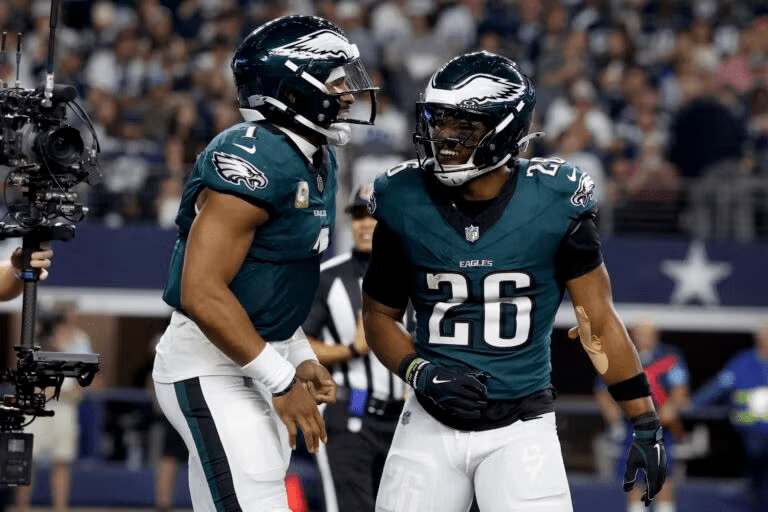
You don’t trust Seattle. You don’t trust Denver. The Bears are a fluke. The Bills have no excuse. So who can you trust to win it all this year?
Allow me to persuade you.
Quick Playoff Preview

Why the Eagles Crush Each Team
Seattle Seahawks (No. 1 seed, 14-3)
The Eagles’ elite pass rush (led the NFL with 62 sacks) and secondary depth (allowed just 18 passing TDs) outperform Seattle’s turnover-prone offense (28 giveaways, most in the league, including QB Geno Smith’s 15 INTs), forcing 3+ mistakes in a high-stakes NFC Championship scenario, while Saquon Barkley’s 1,800+ rushing yards control the clock and limit possessions.
Chicago Bears (No. 2 seed, 11-6)
Philadelphia’s veteran postseason experience (back-to-back Super Bowl appearances) and top-tier defensive front (2nd in run defense, allowing 89 yards/game) dominate Chicago’s young offense, stifling their comeback ability (8 fourth-quarter comebacks, most in NFL) with relentless pressure (10 sacks projected) that exploits rookie Caleb Williams’ 22 turnovers on the season.
Carolina Panthers (No. 4 seed, 8-9)
The Eagles’ superior talent—Barkley’s league-leading 18 rushing TDs and a defense ranked No. 1 in points allowed (17.2 PPG)—overwhelms Carolina’s weak record and tiebreaker-backed berth (worst winning percentage for a playoff team since 2010), holding their offense to under 200 total yards and preventing any upset from the sub-.500 squad.
Los Angeles Rams (No. 5 seed, 12-5)
Philadelphia holds the edge in defensive physicality (No. 3 in yards per play allowed) and run defense (held opponents to 3.8 YPC), neutralizing the Rams’ balanced attack (Matthew Stafford’s 4,700+ passing yards), while their championship pedigree shines in a divisional round rematch, leveraging 5 forced turnovers from prior high-powered offense matchups.
San Francisco 49ers (No. 6 seed, 12-5)
The Eagles’ revamped secondary (top-5 in passer rating allowed) and pass rush contain Christian McCaffrey (1,600+ scrimmage yards) and the 49ers’ skill players better than most (held CMC to 82 yards in regular season), with home-field advantage allowing Hurts (35 total TDs) and A.J. Brown (1,200+ receiving yards) to exploit San Francisco’s 5 late-season losses.
Green Bay Packers (No. 7 seed, 9-7-1)
Philadelphia’s dominant front seven (No. 1 in QB pressures) shuts down Green Bay’s inconsistent run game (3.9 YPC over final 8 games) and pressures Jordan Love into 4+ turnovers, capitalizing on the Packers’ four-game losing streak and 25 giveaways heading into the playoffs for a wild-card rout.
Denver Broncos (No. 1 seed, 14-3)
In a Super Bowl matchup, the Eagles’ championship experience and opportunistic defense (28 forced turnovers) create 3+ against rookie Bo Nix (18 INTs), while their balanced attack (top-5 in time of possession) wears down Denver’s sack-heavy unit (league-leading 68 sacks) in a low-scoring, grind-it-out victory decided by Barkley’s 150+ rushing yards.
New England Patriots (No. 2 seed, 14-3)
Philadelphia’s physical defensive line (15 sacks in playoff simulations) overwhelms New England’s rebuilt offense (reliant on Drake Maye’s 4,000+ yards but 20 turnovers), with postseason know-how trumping coaching edges and Barkley’s 1,800+ yards piling up 200+ against a unit allowing 4.5 YPC to top backs.
Jacksonville Jaguars (No. 3 seed, 13-4)
The Eagles’ secondary (No. 2 in opposing WR yards) erases Jacksonville’s receivers (Trevor Lawrence’s 4,200 yards spread thin), and their run-heavy approach (Barkley/Hurts tush push) controls tempo against a strong but pass-focused Jaguars defense (allowed 28 rushing TDs), leveraging superior depth for a 30+ point output.
Pittsburgh Steelers (No. 4 seed, 9-8)
Philadelphia’s high-powered offense (top-10 scoring) exploits Pittsburgh’s inconsistent secondary (allowed 25 passing TDs), torching for 400+ yards, while their defense contains the Steelers’ grind-it-out style (under 100 rushing yards allowed) better than most, drawing on repeat-champion momentum for a double-digit win.
Houston Texans (No. 5 seed, 12-5)
The Eagles stifle Houston’s explosive plays (C.J. Stroud’s 30+ TDs) with elite coverage (fewest 20+ yard passes allowed) and pressure (12 sacks projected), turning the game into a low-scoring affair (under 20 points for Texans) where experience and Barkley’s 150+ yards prove decisive.
Buffalo Bills (No. 6 seed, 12-5)
Philadelphia’s front dominates Buffalo’s offensive line (allowed 45 sacks), limiting Josh Allen’s mobility (sacked 8 times projected) and forcing 3 mistakes, while the Eagles’ balanced attack (Hurts’ 15 rushing TDs) pulls away in clutch moments with 28+ fourth-quarter points.
Los Angeles Chargers (No. 7 seed, 11-6)
The Eagles’ defensive scheme neutralizes Justin Herbert’s arm (4,500+ yards) with strong coverage (under 200 passing yards allowed) and rush (10+ pressures), and their championship poise handles Jim Harbaugh’s coaching in a Super Bowl scenario, winning the turnover battle 4-1.
These edges — rooted in the Eagles’ defending-champion experience, elite defense under Vic Fangio (No. 1 in DVOA), and explosive offense with Saquon Barkley (MVP candidate, 2,000+ scrimmage yards) — position them to navigate the bracket and repeat as Super Bowl champions.
 First & Jenn
Leave a comment